Showing posts with label Essex. Show all posts

Tuesday, 15 November 2022

Billericay Dickie

Enjoyed appearing on the Ben Fryer show on Radio Essex last week to add my opinion on supermodel and entrepreneur David Gandy telling the Daily Telegraph that he wanted to take his birthplace of Billericay off his passport. The show played segments of Ian Dury's Billericay Dickie and Gavin and Stacey of course to emphasise the town's place in modern culture. 

Does David not realise that Billericay now has a Waitrose? I mentioned the bluebells of Norsey Woods, the Peasants' Revolt, Billericay Brewing, Lake Meadows and the Chequers pub among other Billericay contributions to the world. And also that Adrian Chiles' thought having a regional Brummie accent was an advantage as people underestimated him and were surprised by anything vaguely clever he said — the same surely applies to Essex. Gandy is not a bleeding thickie and he's doing very well, for which he should be thankful.

Friday, 28 January 2022

Culture wars over Essex

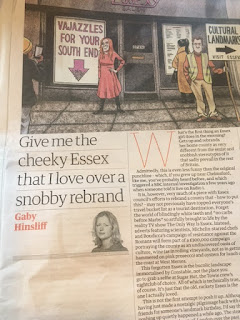
Good piece by Gaby Hinsliff in the Guardian today where she argues, "Give me the cheeky Essex that I Iove over a snobby rebrand." She's referring to Essex County Council's new campaign to emphasise the county as the home of Boudicca, the Peasant's Revolt, Michelin-starred restaurants and fine wineries. Which is all very true, but as I argued in my book The Joy of Essex, there will always be two sides to the county, estuary Essex with its East End overspill, and the posher villages and towns to the north. 

Should Essex ditch the Towie image? It's all sparked a (lack of) culture war. The Sun also covered the debate and PR guru Mark Borkowski made the point: "There’s no denying the cultural — and, I’m certain, economic — impact of Towie on Essex’s fame. For me, the ideal campaign would acknowledge these positives, even use them to introduce lesser-known facets of Essex, rather than using Towie as a sacrificial lamb.”

Discerning visitors surely know that Essex isn't completely vajazzles, though that side of the county can't be disinvented. Just as Upminster boy Ian Dury could indulge in clever wordplay yet also start Plaistow Patricia with a barrage of swearwords, high and low culture can mix. The artist Michael Landy had it right in his Welcome To Essex exhibition at Firstsite in Colchester last summer, where he celebrated lowbrow Essex with high art. 

The PR campaign is well-meaning but you can't air-brush out dodgy Essex. As Gaby Hinsliff writes: "My Essex is a pancake-flat, dead ordinary hunk of East Anglia that has ingeniously vajazzled itself up into something much more interesting by leveraging the idea of Essex as a cheeky, sexy, loudly inappropriate cultural and economic phenomenon... How do you reinvent a place that has already reinvented itself in ways no other county would dare? Try it, and the joke’s on you."

Wednesday, 7 July 2021

Essex and Essexuality

Told you my work is art... My book The Joy of Essex is on display in a vitrine (that's a posh word for a cabinet) in Michael Landy's Welcome To Essex exhibition at Colchester's Firstsite gallery. Also my 1991 piece from the Guardian on the Essex argot.

It's a great show about the county's cultural baggage and media stereotypes, including a giant figure of Essex Man as you enter, tabloid headlines printed on tarpaulins and 1990s TVs on wheelie-bins playing clips of Essex luminaries. The Ilford-born Landy sees himself as a mirror to all the images projected on to Essex — and he's clearly had a lot of fun making this exhibition. Proper art. Runs until Sept 5.


Saturday, 17 April 2021

Odes to Essex

Enjoyed listening to Radio 3's Odes to Essex series. Would any other county have got its own radio series? Billy Bragg had a lot to say about childhood games on the liminal marshland around Barking, an area full of rusting cars, old sofas and girlie magazines. Excellent Essex author Gillian Darley take on mid-Essex, poet and novelist Lavinia Greenlaw looks at the refusal of place through her childhood in an Essex village and night trips across muddy fields trying to get somewhere, while writer Ken Warpole speaks of the Canvey Island floods and Essex's radical past. Well worth a listen. Click on the link to play.

Monday, 28 December 2020

Towie oil traders cash in

We had The Wolf of Wall Street, the Wolf of Shenfield and now it seems the Wolves of West Horndon. The Daily Mail contains a great story about nine 'Towie oil traders' operating as Vega Capital London out of an industrial park in West Horndon, who have made a claimed £487 million trading in futures, gambling on the price of oil going down during the pandemic. 

Even better three of the Essex high-rollers are nicknamed Cuddles, Ari and Dog, support West Ham and like to visit Marbella. The only downside to their nice little earner is a trading lawsuit from the US, though the so called 'oil oiks' insist they acted on a 'blaring market signal'. Essex Man is nothing if not entrepreneurial and really futures trading can't be that different to trading on Romford Market. Though you do wonder how they'll spend all that money in West Horndon — it's only got one pub and one restaurant. Expect a movie very soon.

Wednesday, 14 October 2020

This is Essex — without the stereotypes

Enjoyed the Zoom launch of the video This is Essex today. The video was made by Visit Essex and contains a host of Essex characters debunking some of the myths about the county. 

To prove it's not all boy racers rally champion Nabila Tejpar (left) shows us her motor. Countering the idea that Essex folk aren't that intelligent, scientist Dr Miles Adcock shows us around the Chelmsford base where parts are made for space programmes. 

Comedian Ellie Taylor, who was born in Brentwood, gives her take on the Essex accent. Michelin starred chefs the Galvin Brothers prove that Essex does have taste and eighth generation Mersea oysterman Tom Haward proves "Out, Out" doesn't always mean false eyelashes and fake tan. 

Paralympian Anne Wafula-Strike reveals tracksuits are worn for more than leisure in Essex, Hedingham Castle owner Demetra Lindsay tells us she's an Essex Girl and metal detectorist Adrian Gayler brings a new perspective to golddigging. Harwich town cryer James Cole gets shouty and the owner of West Street vineyard asks what a sugar hut is. Although pantomime dame Anthony Stuart-Hicks does admit to wearing white stilettos. 

Essex Radio's Dave Monk hosted a short discussion after the launch. Essex Man, Essex Girls and Towie might represent a part of estuary Essex, but this is a fun idea to prove that there's a lot more to Essex than the popular cliches. To view the video click on the link.

Thursday, 2 April 2020

Stag do in Harold Hill


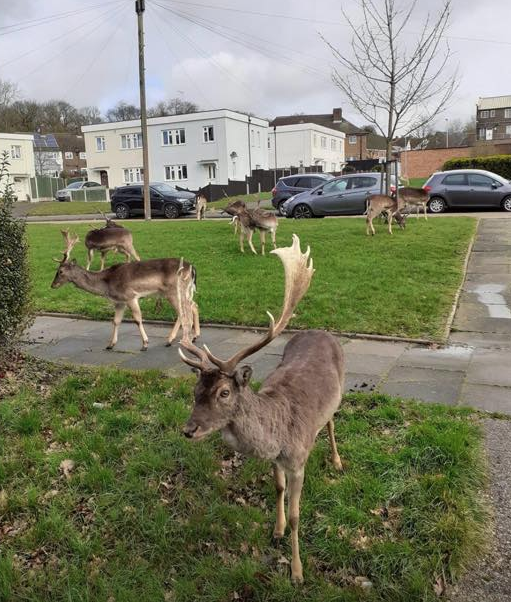
Oh deer. Thanks to Billy Bragg who has retweeted these pics of deer who have colonised the empty streets of Harold Hill (in East London, though formerly Essex). The goats in Llandudno are getting all the publicity, but it seems deer are now born free in Harold Hill (which incidentally also features in an Ian Dury song).

Tuesday, 10 March 2020

Excellent Essex

Good to see there's a new book on Essex out, Excellent Essex: In Praise of England's Most Misunderstood County by Gillian Darley. The Guardian described it as, "an original and beautifully written celebration of a much maligned county." A review will be published shortly…

Monday, 25 November 2019

West Ham Legends hit Brentwood

Best part of the weekend was going to see 'West Ham Legends' Trevor Brooking, Julian Dicks, Frank McAvennie and Tony Gale at Brentwood Live on Friday night. Brentwood Live is a strange venue, basically a sports hall with seats and not actually in Brentwood but Doddinghurst. But a taxi trip from the station soon delivered Fraser and myself to the venue, where we found a thousand or so geezers in replica shirts and Camden Pale on draft.

Tony Gale was a fine compere for the evening, full of wit, delivering a surprisingly accurate impression of Sir Trevor Brooking and revealing that Trev once said a four-letter word on the golf course. Sir Trev stalked us through his FA Cup winning goal and said that although Ron Greenwood was a great coach John Lyall was a better man manager. Predictably he rather sat on the fence on possible replacements for Pellegrini, but did say that he thought Ajeti wasn't good enough. Dicksy added that the current side just doesn't work hard enough. Mention of Roberto inspired memories of Allen McKnight from Frank McAvennie.

There were lots of tales from the 1980s and 1990s. Frank McAvennie had a story of the players breaking a curfew in Amsterdam and John Lyall asking for £50 to be given to charity from every player who had sneaked out of the fire escape. Lyall was very surprised to find £1200 left on the table when he returned. There was also the story of Mitchell Thomas faking injury so that McAvennie could come on to score a hat-trick in his final West Ham game.

We had plenty of examples of footballers' banter. Tony Gale recalled the time Trevor Morley was in the treatment room after being stabbed by his wife and Julian Dicks had placed a series of knives in the anatomical skeleton on display. 

Dicksy remembered himself and Frank hitching a lift on a milk float during a cross country run under Billy Bonds; and also the time Billy Bonds wanted to fight him at half-time during a game at Coventry. Despite their differences though, Julian considered Bonds to be the best player he played alongside.

Everyone had massive respect for Bonzo and when asked by an audience member "Did Harry Redknapp stab Billy Bonds in the back?" Tony Gale replied that all he could say was that Billy was as honest as they come.

Tony Gale also revealed that the epic 1985-1986 season charge to third place was inspired by a pre-season defeat at Orient when a fan who looked like a member of the ICF broke into the dressing room and lambasted each player in turn. If that fan is still around then perhaps he could break into the dressing room again and deliver a few more ripostes to our underachieving side.

Overall a fine night of nostalgia from four players who still seem to enjoy each other's company. And what wouldn't we give to see these four back in the side today?

Monday, 26 August 2019

Stiletto crazy after all these years...

Some of the donated stilettos           PIC: QUEENS THEATRE
Stilettos will be theatrically burned to mark a new series of plays touting a positive image of Essex at the Queen's Theatre in Hornchurch.The theatre is asking for donated stilettos to burn during Sadie Hasler's play Stiletto Beach, billed as "a love letter to Southend". 

The season also features So Here We Are by Luke Norris, which is also set in Southend and part of the theatre's Essex On Stage programme. So far the theatre has received more than one hundred pairs of stilettos — which should help the play right some burning injustices perpetuated by Essex Girl stereotypes. Click on the link for box office details...

Friday, 9 August 2019

What have the Romans ever done for Essex?

Just enjoyed a day trip to Colchester. Arriving at Colchester Town rather than Colchester station meant a fine view of the ruins of St Botolph's Priory from the train. Exploring the ruins in closer detail they're a fascinating mass of huge cylindrical columns and arches made of recycled Roman brick and stone trashed by Henry VIII. Yet in historic Colchester they are almost an affterthought.

Colchester Castle was as magnificent as ever and it's still an immense thrill to take a tour of the foundations, which are those of the Roman temple sacked by Boudica's Iceni tribes. The museum has some great finds including the beautiful gold bangles and earrings found under Fenwick's department store in the charred layer of town left by Boudica's rampage. Plus there's the Roman doctor buried with a complete surgical kit, the tombstone featuring a Roman Centurion trampling over a defeated Brit, and the magnificent Colchester vase with it's gladiators and whips.


Then it was on to the Balkerne gate with its two intact arches and an astonishing mass of preserved Roman city wall. My sister and I still had time to make it the Firstsite art gallery before catching the six o'clock train back to London. Colchester has just as much history as town s like Bath — it really should be a top tourist attraction.

Sunday, 30 June 2019

The invention of Essex

Good piece in Friday's Guardian on "the invention of Essex" by Tim Burrows. It covers similar material to my own tome The Joy of Essex: the rise of new housing in Basildon, Harlow and South Woodham Ferrers; Thatcher's appeal to council-house buyers; Simon Heffer's invention of Essex Man in 1990; Birds of a Feather; Mike Leigh's Abigail's Party (set in Romford); the creation of Essex Girls; Basildon Man; and uber Brexiteer and stereotypical Essex Man Mark Francois, MP for Rayleigh and Wickford. 

Burrows ends up concluding that Essex Man is a good shorthand for politicians who claim to identify with working class culture and that actually the county is more diverse than is realised. "If Essex did not exist they would have to invent it."

Thursday, 16 May 2019

Billericay Dickie in a tuk tuk

Another triumph for Essex. Billericay resident Matt Everard has set the world record for speeding in a tuk tuk. Matt reached a speed of 74.306 mph at an airfield near York. Everard, 46, fell in love with tuk tuk taxis after holidaying in Thailand. And after a few beers in Billericay, he bought one on eBay while his wife was asleep, as you do, and then spent £20,000 on souping it up. The media loved it of course, and even Radio 4's Today mentioned "boy racers" within a few sentences. At least it should be a talking point when stuck in traffic and just the thing for taking an open-air cruise down the A13, trunk road to the sea.

Monday, 13 May 2019

Is Prittlewell the new Cairo?

Tutankhamun might sound like a Southend nightclub to rival the old Zero 6 or the Canvey Island Goldmine, but it seems that Prittlewell is now home to Britain's version of the Valley of the Kings. A massively important archaeological find, descrived as "Britain's Tutankhamun", has been made — an Anglo Saxon burial chamber between an Aldi and a pub. Years of research on the tomb, discovered in 2003, suggests that Essex was at the heart of Anglo-Saxon culture and clearly this top geezer had much better bling than Sutton Hoo. 

Dating back to AD 616, this powerful man (who might have been Seaxa, brother of King Sæberht and son of Sledd) was buried with a copper-alloy flagon, a lyre, drinking horns and elaborate blue glass drinking cups. An indication that Essex Man back then was also into drinking, music and a bit of flash gear. It 
would have taken 25 people a week to build the tomb. It would have been a natural spot for a prestigious monument — what great man wouldn't want good afterlife access to Aldi, an Essex boozer and the Arches cafes at Southend? 

The Observer suggested that Southend might be on the way to becoming the new Cairo — though business at Southend Central Museum has been a little slow so far. Still, give it time, and soon Southend will surely be on every cruise ship's itinerary.

Thursday, 4 April 2019

Moore bewitches Leigh-on-Sea

After my recent trip to Leigh-on-Sea finally got round to reading Syd Moore's ghost story The Drowning Pool. It's refreshing to find a novel set entirely in Leigh. Moore's story concerns a widowed teacher Sarah who is haunted by her namesake Sarah Grey, whom legend claimed was a local witch. Moore based her idea around the real-life legend of Sarah Moore the so-called sea-witch of Leigh, who died in 1867. It was claimed she could curse ships.

The novel certainly has a very strong sense of place and all the characters do very Essex things, such as drinking large amounts of wine to numb the apparitions, boozing in the Crooked Billet and going up to Hadleigh Castle. I once appeared with Syd Moore at the Essex Book Festival offering advice to local writers, and very good company she was too. She's written a number of Essex witch stories dealing with the dark history of Essex's witch hunts and she's worth reading if you like a good murder story and lashings of local history. Even if the body count in Leigh does seem to be disturbingly high...

Monday, 11 March 2019

Sunshine on Leigh

The Crow Stone at high tide
Enjoyed a fine weekend trip to Leigh-on-Sea. A mixture of sunshine and strong winds made for a very enjoyable walk along the beach, watching the choppy waters of the estuary at high tide and seeing windsurfers shoot across the waves. Our party's dogs Vulcan and Livvy enjoyed being allowed to race across the sand towards Chalkwell, surely the most scenic commuter station in the country. 

We looked around the Leigh Heritage Centre in the Old Town and learned a lot about the history of Leigh, which was once a deep sea port and home to an impressive shipbuilding industry, before silting eroded its role. The centre also has a renovated fisherman's cottage attached, where the parents and eight children would have slept upstairs. The day was rounded off by excellent fish and chips in the Crooked Billet and a pint of Jack The Lad IPA. Forget Kent, Londoners in need of the sea can find the charms of Leigh just half an hour from Barking on the C2C line.

Monday, 4 March 2019

Firestarter dimmed

Very sad to hear of the death of the Prodigy's Keith Flint at his home in Dunmow. Keith had a difficult upbringing in Braintree, but always retained strong links with Essex. He looked demonic but according to DJ Jo Wiley he was "an absolute sweetheart" in real life. And in happier times, Keith had a sense of humour. Love the story that at the pub he owned, the Leather Bottle in Pleshey, he had a jar into which customers had to put a pound every time they made a Firestarter joke when he lit the pub's fire. The twisted Firestarter will be missed.

Thursday, 17 January 2019

Robert the Essex geezer

Was Robert the Bruce born in Essex and not Scotland? Could the King of the Scots have been an Essex Man? The best historical claim of last year came in a book on Bruce called Traitor, Outlaw, King by historian Fiona Watson. Dr Watson claims that one 14th century chronicler writes that Bruce was born in Writtle, rather than Ayrshire. So it's quite likely that he took on the English at Bannockburn wearing a Barbour jacket and a flat cap, hollering, "'Ave some of that!"

Friday, 2 November 2018

Jaywick kicks up a storm in US politics

One of the publicity shots for Benefits by the Sea
Hard to believe that Jaywick is now causing shockwaves in the United States' midterm elections. Just watched the recording of Have I Got News of You and a picture of Jaywick was one of the picture quiz items. Host Victoria Coren, Paul Merton, Ian Hislop, Judge Rinder and Janey Godley had a lot of fun with the image. The picture of Jaywick, complete with potholes and dilapidated homes, came from the Facebook campaign of Nick Stella, a Republican ally of Donald Trump. Over the picture of the Essex village it announced, "Only you can stop this from becoming reality." Today's Guardian has a feature on the furore. 

Stella's campaign has caused predictable outrage in Essex, with the locals pointing out that the US has plenty of dodgy trailer parks it can photo, and in any case the Jaywick road has now been covered in tarmac and many improvements have been made to the village since it was declared the most deprived neighbourhood in the UK in 2005 and then featured in the TV programme Benefits by the Sea. The locals are right. Jaywick might have had its problems, but it has a lovely beach and a lot of potential now the council is putting some investment into the place. It's not ready to be part of the US rust belt just yet. 

Wednesday, 3 October 2018

Getting your Munnings worth in Dedham

This is a guest post by Nicola Baird reproduced from the blog Around Britain Without A Plane

The village of Dedham is in a sublimely pretty corner of Essex — especially on an autumn day. Tourists come here on an art pilgrimage seeking to find out more about two artists with deep connections to this East Anglian landscape. Many of us are familiar with Constable and his famous horse-drawn 'Haywain', painted at nearby Flatford Mill, but what about the equestrian artist Alfred Munnings (1878-1959)? 


Books about Munnings at the Munnings Museum shop.
Munnings excelled as a 
plein air painter, capturing the good times and summer light,
and starring beautiful horses, girls in frothy dresses, canvases filled with gypsy life,
backdrops of the River Stour countryside, racehorses. 

I love horses but they are horrible to draw: those sleek limbs bend so awkwardly when my pencil tries to fix them to paper. And their hooves! How does a horse stand on such a little sloping triangle? These are not questions you need to ask when you see the work of Alfred Munnings hanging at his dream home, Castle House just outside Dedham. His horse canvases are so realistic you can almost smell the sweet hay breath of his subjects.

If you know your horses you can see the thickened tendons of a racehorse turned hunter, the tucked up posture of a horse on the first world war front line, the tail flick of a gypsy pony brushing away a summer fly. But mostly Munnings paints the most beautiful horses, at peak condition. A lot of these were his own horses. Perhaps his most famous works are the race starts (which bizarrely I find I confuse with Degas' paintings) and the colourful carnival of travellers at Epsom Down during Derby race week or at horse fairs like Lavenham in nearby Suffolk.

As a bonus the gallery has a wonderful cafe open two hours before the exhibition. The food is terrific and the setting bucolic — green lawns, green fields, birdsong.

This is easy art: Munnings had an eye for beauty with a happy focus on horses and good looking women. For that period he was rather old-fashioned although that didn't stop him liking a party. Born on 8 October in 1878, Munnings was brought up in a mill, just like the one Constable painted in the Haywains (Flatford Mill). His natural artistic skills saw him apprenticed to a lithograph printer at 14-years-old. Over the years he developed a conservative style that many art critics lampooned. At the same time he had real antipathy to modern art (eg, Picasso, Henry Moore, Salvador Dali). Indeed his resigning speech as the President of the Royal Academy, in 1949, focussed exactly on modern art's limitations. It didn't go down that well with the diners.

Munnings was embroiled in the hunting set and made a good deal of money doing expensive portraits for the Belvoir Hunt followers, and others. His first big London show was in 1913, Horses, Hunting & Country Life at Leicester Galleries. By the 1920s he could charge £500 a canvas, which is £21,000 in today's money. He met his second wife Violet McBride, who loved to hunt, at Richmond horse show, and she clearly brought him social status and many equestrian commissions. Munnings did follow hounds but apparently he enjoyed long hacks on his own even more.

He bought his first horse when he was in his 20s and kept riding until the end off his life. Munnings knew how much he owed to his horses (quoted in the book pictured above AJ Munnings by Stanley Booth on sale at the Munnings Museum): "Although they have given me much trouble and many sleepless nights, they have been my supporters, friends — my destiny in fact. Looking back at my life, interwoven with theirs - painting them, feeding them, riding them, thinking about them — I hope that I have learned something of their ways. I have never ceased to understand them."

Munnings Museum is in this yellow painted house. When AJ Munnings moved
here he called it his "dream home".
At the collection my friend Eugenie and I quickly found favourites. Eugenie loved Shrimp, the young traveller man often painted on a cheeky grey Welsh pony called Augereau.

I fell for a showstopper, painted in 1932 - My Wife, My Horse, Myself. It's a conceited but beautiful painting of Lady Munnings riding sidesaddle on a stylish English thoroughbred outside her beautiful country home, in the corner her proud husband smiles by a canvas of the same painting. It's a show off portrait of Munnings' possessions, capturing the swank (albeit horse-centred) lifestyle of this miller boy-made-establishment. 


It also owes plenty to the then popular hunting writer, Surtees who barked (surely he must have barked!): "Three things I never lend - my 'boss, my wife and my name." It was exhibited at the Royal Academy in 1935, a rocky time in British finances, which might well be why it's also been dubbed: "The most defiantly British picture of the 20th century". Strangely it's the sort of insult that Munnings would have been taken as a compliment.
Painters Constable and Munnings would still recognise the River Stour at
Flatford Mill, just in Suffolk. It's now a very popular tourist spot.
I'm a huge fan of dogs and horses so it's always been painful to me that the late Victorian and early Edwardian animal painters, in particular Munnings but also Landseer (who painted Monarch of the Glen) and the stunning equestrian artist Heywood Hardy, all fell out of fashion as the shock of the new art exerted its magnetic pull. Country life may not have ended in the 1930s, but it feels as over as the time when families crowded into the mill cottages, six sharing a bedroom, and never left the country, never mind the country. You can see exactly what I mean if you visit the little National Trust property (free entry) a few miles over the fields at Flatford Mill.

But that doesn't stop a real sense of joy when you see Munnings' wonderful paintings (this collection has more than 4000) in his old home in this elegant Georgian family house. It's a visual delight to go into every room, and the studio, and see pictures which such a strong sense of place (there are around 150 on display).

I've been longing to see Munnings' paintings, but took my time figuring out
how to get from Manningtree train station, Essex (seen here with a glowing sunset).
 
Munnings' work can be written off as sentimental or chocolate-boxy (if you really don't like horses that is) but he had such grit. Next year expect a complete rehang as Castle House is taken over by the 1918 portraits Munnings did of the Canadian Cavalry Brigade as a war artist on the front line in France.

Munnings, by then pushing 40, has been blinded when he was just 19. For most of us a thorn striking your eye would be a life disaster. For a teenager starting out on his artistic career, without much money behind him, this should have signalled the end. Somehow Munnings overcame the disability forcing his sole good eye to let him paint well — damn well — again.

Gallop over to see his paintings in the house where he lived if you get the chance. And don't forget to take a break at the Garden Cafe.

How to get there: An early autumn day was perfect for the four or so mile walk across the
water meadows from Manningtree station via Flatford Mill (plus 20 more minutes from Dedham village). A friend with a car was a bonus. There are also taxis from Manningtree and a bus (see Munnings Museum website, then double check with coach provider).

  • More info at https://www.munningsmuseum.org.uk 
  • Address: Castle House, Castle Hill, Dedham, Colchester, Essex CO7 6AZ
  • The museum closes for the winter on 31 October 2018 and reopens approx Good Friday (April 2019), check website. Admission is £10.
  • Check Garden Cafe opening times cafe@munningsmuseum.org.uk, tel: 01206 322127 (option 5)